University of Liverpool Overview: History and Identity, Doubly Certified
The University of Liverpool is a public research university in the north-west English port city of Liverpool. Its history traces back to University College Liverpool, founded in 1881, and it received its royal charter in 1903, formally becoming a university with the power to award its own degrees. As one of the UK’s celebrated “red brick” universities and a founding member of the “Russell Group”, Liverpool holds a firmly established place in the British higher education system.
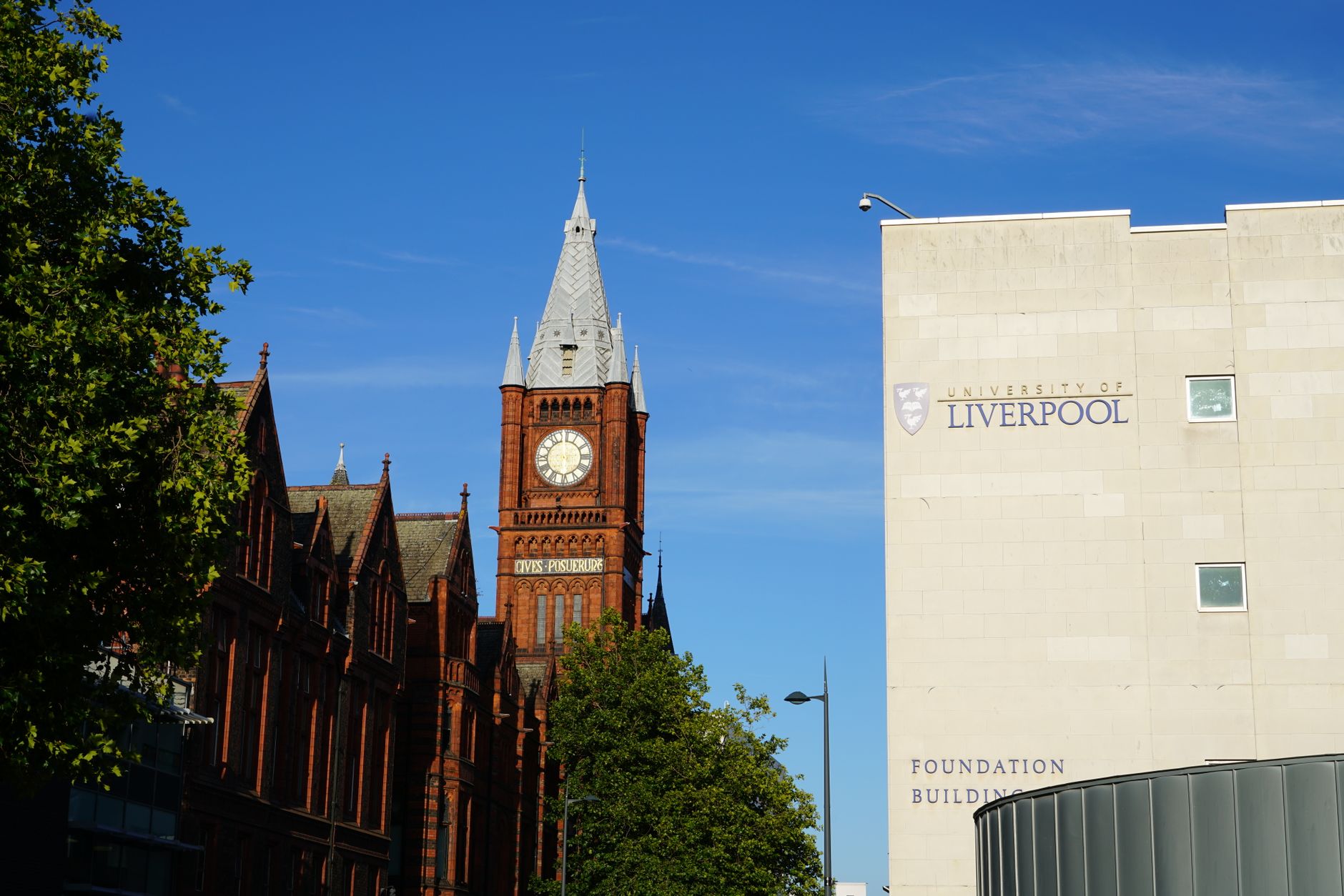
The main campus sits in the Brownlow Hill area of central Liverpool, a short walk from the bustling commercial district and the famous Albert Dock. The Victoria Building, the campus’s architectural centrepiece, is part of the city skyline with its signature red brick and clock tower — a symbol of the university’s more-than-a-century-long symbiosis with the city of Liverpool.
Key Data at a Glance: Scale, Rankings and Composition
For students and parents encountering this university for the first time, the following key figures sketch the institution quickly:
- Founded: 1881
- Type: Public research university
- Affiliations: Red brick universities, the Russell Group, and the N8 Research Partnership
- Student body: more than 29,000 students in total, with international students from over 130 countries forming a culturally diverse learning community.
- Academic structure: three faculties — Humanities and Social Sciences, Health and Life Sciences, and Science and Engineering — covering numerous departments.
- Degree-awarding power: conferred by the UK Privy Council; qualifications fall within the certification framework of the Chinese Service Center for Scholarly Exchange (CSCSE).
Academic Reputation and Flagship Subjects
Liverpool is no mediocre “big and broad” institution; it is a university with deep academic traditions and global influence in specific fields. Since its founding it has produced nine Nobel laureates — a telling measure of its fundamental research strength.
Its disciplinary strengths are worth noting in particular:
- Architecture and urban planning: a traditional strength, with an architecture school held in very high regard across the UK. For Chinese students, studying here means working directly with a “living textbook” of architectural heritage and urban regeneration practice.
- Clinical medicine and dentistry: backed by a large network of teaching hospitals and a life sciences cluster, medicine and dentistry are among the university’s most demanding entry standards and densest research output.
- Oceanography and earth sciences: thanks to its location on the Irish Sea, Liverpool has formidable research strength in marine science and earth and ocean engineering, with dedicated research facilities.
- Music: Liverpool is the home of the Beatles, and the music industry is the city’s soul. The university’s music department offers not only traditional musicology but deep engagement with popular music research and music industry management — a distinctly local flavour.
- Engineering and computer science: as a Russell Group member, its engineering faculty maintains high-standard teaching and research in materials engineering, aerospace engineering and, in recent years, the fast-growing field of computer science.
The Chinese Student Community and Campus Culture
Liverpool hosts one of the largest and longest-established Chinese student and scholar communities in the UK. The university runs dedicated international student support services, and the Chinese supermarkets, restaurants and active Chinese student societies around campus give newcomers a convenient buffer for adjusting to life abroad.
More importantly, the university’s partnership with Xi’an Jiaotong University in founding XJTLU has given it exceptional name recognition in China. This brings a vast Chinese alumni network and means many Chinese families already know and trust this British university before their children leave home. That close connection has given Liverpool deep experience in supporting Chinese students.
In campus culture, Liverpool is pragmatic, open and energetic — neither as stiff as some ancient universities nor as fast-paced as London institutions, blending the warmth of a port city with the rigour of a red brick. Several scenes in the Harry Potter films were shot in the campus’s Gladstone Library, adding a touch of magic to everyday study life.
Admission and City Life Essentials
Liverpool is a large British city where living costs run far below London — a very practical advantage for families watching their study-abroad budget. The university guarantees university accommodation to all international new students who apply within the normal timeframe, something few UK universities offer.
To be clear, competition for places varies by programme. Flagship subjects such as clinical medicine, dentistry and architecture impose very strict academic and language requirements, while most other programmes have more flexible entry standards. Undergraduate course applications generally go through UCAS; taught master’s applications go directly to the university.
Prospective students and parents should always rely on the latest prospectus and language requirements published on the university’s official website — this information updates constantly and directly shapes your application strategy.
Basic information in this article compiled from public sources as of 30 July 2026. For the latest admissions policies, fees and rankings, always refer to the university’s official announcements.